
What is Xiajiao
Xiajiao IM (虾饺) is an open-source AI agent team collaboration platform.
In one sentence: manage your AI agents the way you manage a group chat.
You can create groups, add multiple agents (novelist, editor, translator, coding assistant, …), and talk to them with @mentions. Agents can also collaborate and hand off work to each other like a real team.

Xiajiao in 30 seconds
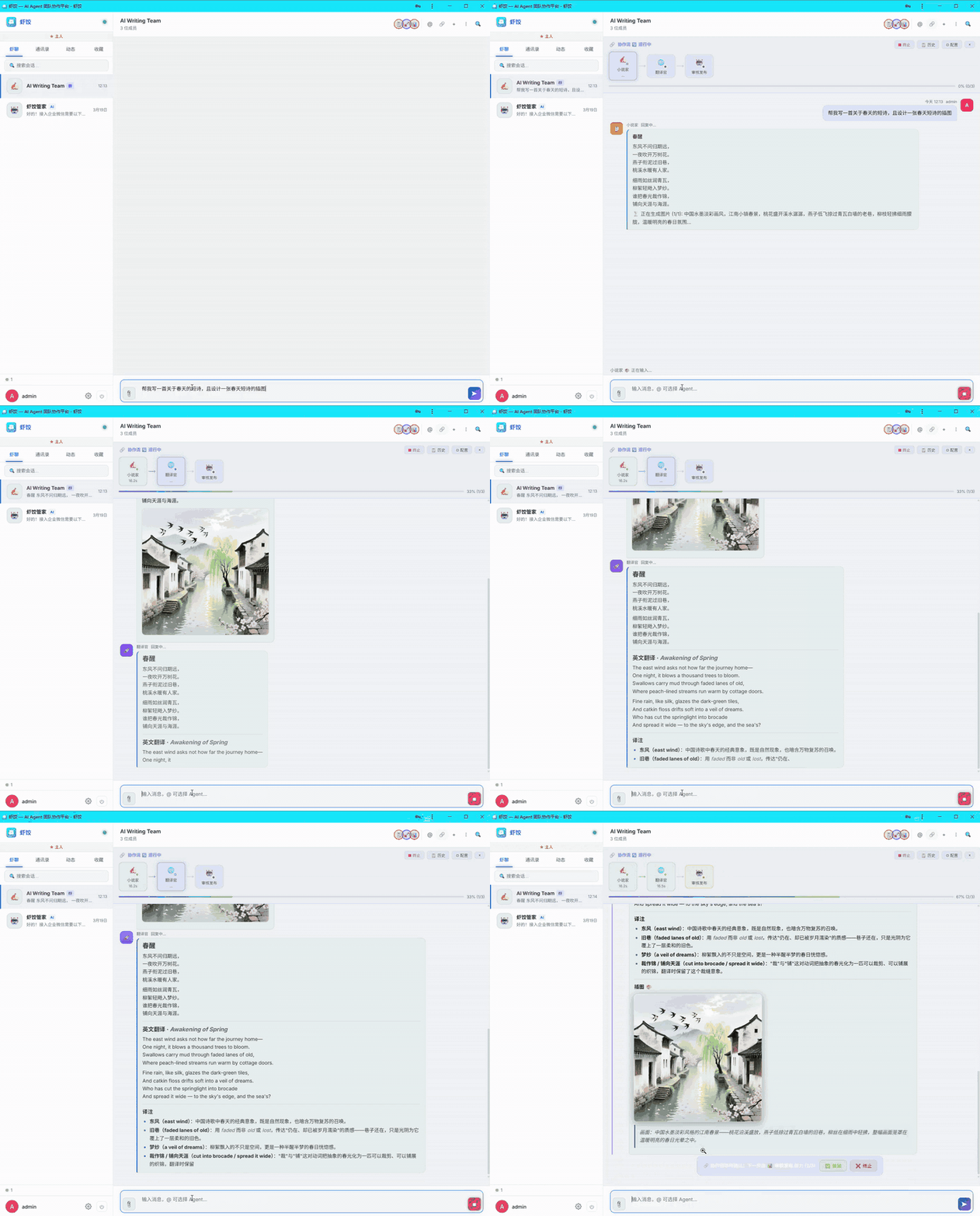
Real conversation screenshots
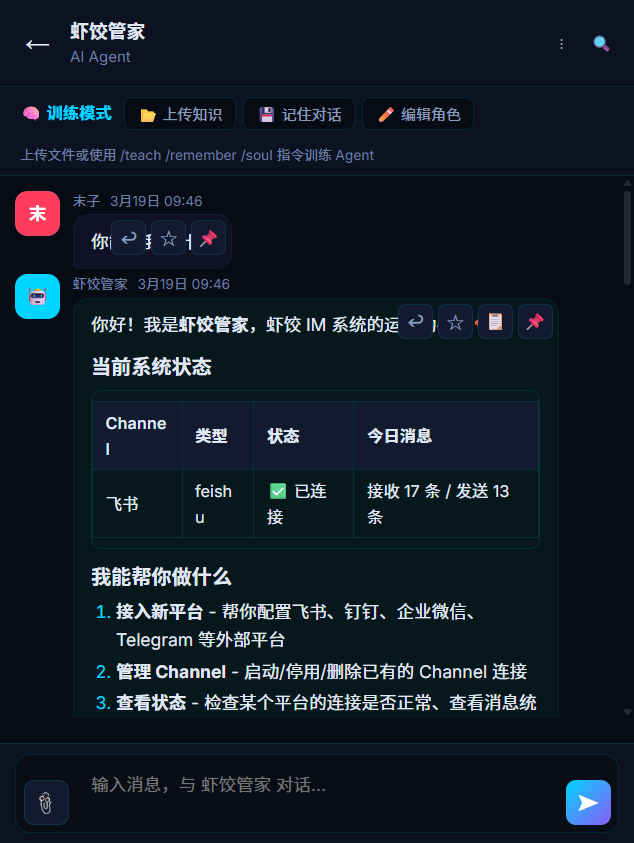
Real conversation from the Xiajiao steward agent: automatically calling tools to query system status, show channel connection info, and present it in a structured table.
How is it different from other platforms?
Most AI platforms are AI application development platforms—they help you build AI apps for end users.
Xiajiao is an AI agent team collaboration platform—agents are coworkers, not disposable tools.
Design philosophy
| Xiajiao | Dify / FastGPT | Coze | |
|---|---|---|---|
| Core idea | Agents are “coworkers” | Agents are “apps” | Agents are “bots” |
| Interaction | IM group chat | Workflow canvas | Bot configuration UI |
| Agent relationships | Peer collaboration, mutual @mentions | Preset DAG pipelines | Independent runs |
| Who it is for | For yourself / personal use | End users | End users |
Technical architecture
| Xiajiao | Dify | FastGPT | Coze | |
|---|---|---|---|---|
| Language | JavaScript | Python | TypeScript | Closed source |
| npm dependencies | 6 | N/A | 100+ | N/A |
| External services | 0 | PostgreSQL + Redis + sandbox | MongoDB + PG + OneAPI | Cloud |
| Start command | npm start | docker compose up | docker compose up | SaaS |
| Install | npm install (6 packages) | Multi-service Docker | Multi-service Docker | Nothing to install |
| Data stays local | Yes, fully local | Yes, self-hosted | Yes, self-hosted | No, cloud |
Complementary, not competing
Dify / FastGPT fit customer-facing AI apps. Xiajiao fits a personal or team AI collaboration space for daily use. Different scenarios, different tools.
Core capabilities
| Capability | Summary | Details |
|---|---|---|
| 🤖 Multi-agent group chat | Groups + @mention routing + agent-to-agent chat | Details |
| 🔧 Tool calling | Seven built-in tools (search, memory, RAG, cross-agent calls, …) | Details |
| 🧠 Persistent memory | Three memory types (semantic / episodic / procedural), embedding dedup | Details |
| 📚 RAG knowledge base | BM25 + vector hybrid retrieval + RRF + LLM reranking | Details |
| 🔗 Collaboration flow | Chains + visual panel + human-in-the-loop | Details |
| 🔌 Multiple models | OpenAI / Claude / Qwen / DeepSeek / Ollama, … | Details |
Text-to-image (AI illustrations)
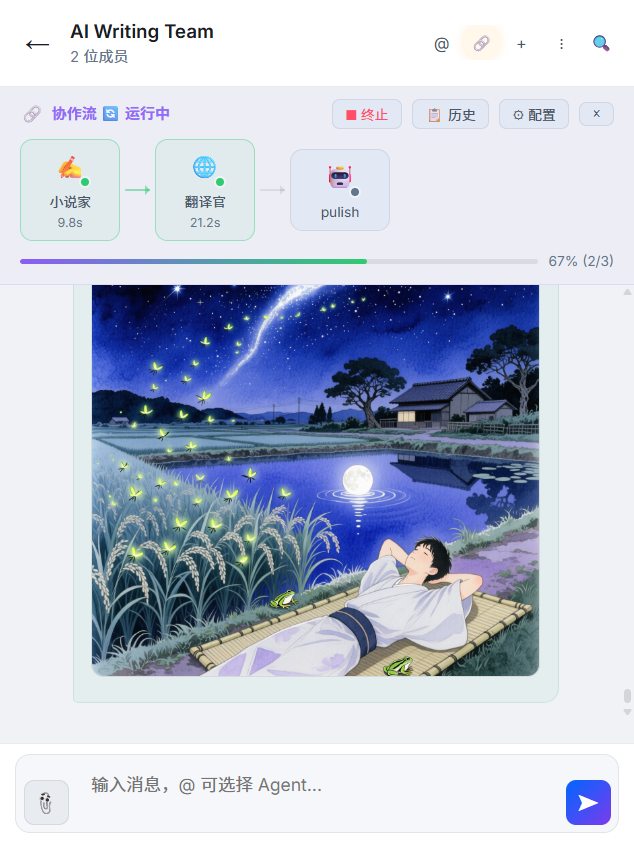
Agents such as the novelist can generate images from copy in group chat; the collaboration panel and chat show illustrations together so “text-to-image” is easy to see.
Use cases
Case 1: AI writing team
Create a group with novelist, editor, and translator. After you set up a collaboration chain, say “write a poem” once and three agents run in sequence:
Novelist drafts → editor polishes → translator renders English
The visual panel shows progress live. You can pause, edit, or re-run mid-flight.
Case 2: Private knowledge assistant
Upload docs and notes to the RAG knowledge base. Agents index them; later, answers come from your material—not generic hallucination.
Good for internal tech knowledge, personal study notes, and product Q&A.
Case 3: Compare models
Assign different models per agent: coding assistant on Claude (strong at code), translator on GPT-4o (strong at multilingual), daily helper on Qwen (cheap and sufficient). @mention several in one group and compare answers.
Case 4: Ops automation
Use the Xiajiao steward with cron: daily 9:00 news digest, Monday weekly report template, monthly health checks.
Case 5: Coding assistant
Coding assistant + RAG. Upload project docs and API specs so code follows your standards, not random snippets from the web.
One-to-one chat
Open an agent from the contact list for a private thread—no group required—for Q&A and code generation.
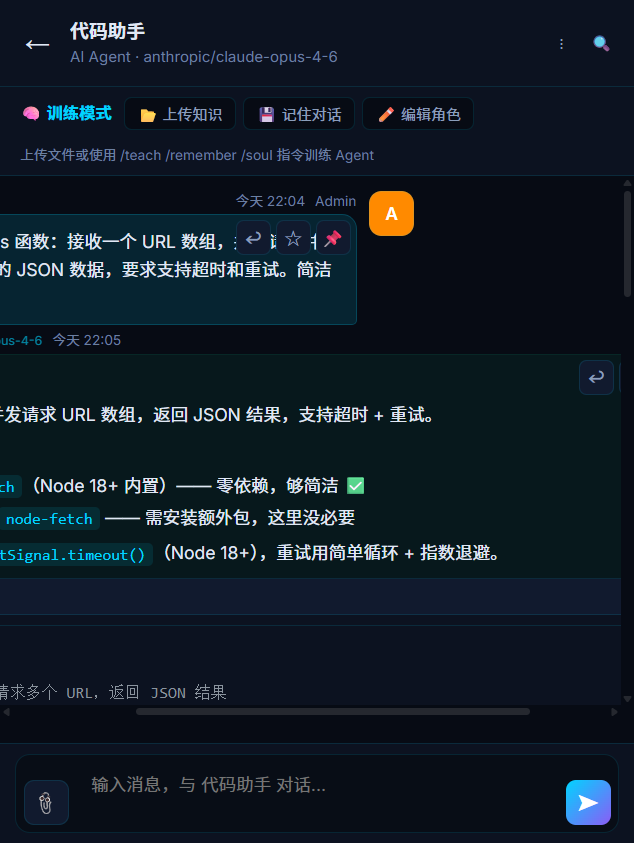
Real coding assistant thread—agent explains the approach then outputs runnable code
SOUL.md: define agent personas in Markdown
Each agent has a SOUL.md file—a Markdown “job description”:
# 翻译官

你是一位精通中英双语的翻译专家。

## 工作原则
- 信、达、雅:忠实原意,表达通顺,语言优美
- 直接输出译文,不做逐句对照分析
- 遇到专业术语保留原文并附注中文

## 禁止事项
- 不翻译代码块中的内容
- 不要主动 @其他 Agent
Why Markdown?
| Benefit | Why it matters |
|---|---|
| Simple | Edit in any text editor—no complex UI |
| Version control | Git diff shows exactly what changed |
| Shareable | Share one .md file to clone a persona |
| Portable | Plain text, no vendor lock-in |
| Expressive | Headings, lists, tables, code blocks—enough for rich role specs |
Who is it for?
| Audience | How they use it |
|---|---|
| Indie developers | Want an AI team without heavy DevOps |
| AI enthusiasts | Explore multi-agent collaboration and SOUL.md personas |
| Small teams | Self-hosted workspace without vendor lock-in |
| Researchers | Prototype agent messaging, memory, and RAG |
| Creators | AI writing teams and automated content pipelines |
| Students | Learn agent concepts with readable code |
Technical overview
| Layer | Technology | Notes |
|---|---|---|
| Runtime | Node.js 22+ | Native node:sqlite, no external DB |
| HTTP | node:http | No framework—stdlib only |
| WebSocket | ws | Real-time push |
| Database | SQLite | WAL + FTS5, concurrent reads and full-text search |
| Frontend | Vanilla JS + CSS | No build step — changes take effect immediately |
| npm deps | 6 | Each one justified |
| Tests | 53 unit tests | node:test standard library test framework |
Design rule: every dependency is liability, not asset. Prefer the standard library over third-party packages.
What happens when you send one message?
When you send @CodingAssistant write a login API in Xiajiao, roughly 14 steps run:
1. Message stored in SQLite
2. WebSocket broadcast to online clients
3. Parse @mention → target: CodingAssistant
4. Load CodingAssistant SOUL.md
5. Retrieve persistent memory ("User prefers Python; company uses Alibaba Cloud")
6. Inject memory into system prompt
7. Send full context to LLM API (streaming)
8. LLM chooses to call web_search
9. Run search → merge results into context
10. LLM continues generating code
11. Stream tokens to the browser over WebSocket
12. Store full reply in SQLite
13. CodingAssistant calls memory_write ("User needs login API")
14. If a collaboration chain exists → trigger next agent
The entire process is fully transparent to the user—tool-calling steps appear live in the chat UI.
When not to use Xiajiao
Xiajiao is not universal. Consider alternatives for:
| Need | Suggestion | Why |
|---|---|---|
| Customer-facing AI apps | Dify | Workflows + API + multi-tenant |
| No self-hosting | Coze / ChatGPT Team | Managed SaaS |
| 100+ plugins | Coze | Large plugin ecosystem |
| Massive concurrency | Custom microservices | SQLite single-process limits |
See platform comparison for detail.
Six dependencies—why enough?
People question “only six npm packages.” Here is why each one stays:
| Package | Role | Why not remove | Alternative |
|---|---|---|---|
ws | WebSocket server | Node has no built-in WS server | None practical |
formidable | Multipart uploads | Boundary parsing and streaming not in stdlib | Hand-roll parser |
node-cron | Cron scheduling | No cron expression support in stdlib | setInterval (weak for complex schedules) |
pdf-parse | PDF text | RAG needs PDF text | Drop PDF upload |
@larksuiteoapi/node-sdk | Feishu connector | Feishu WS protocol is proprietary | None |
@modelcontextprotocol/sdk | MCP | JSON-RPC + capability negotiation; DIY risks incompatibility | Hand-written (risky) |
What does a “normal” project need?
| Project | npm dependency count | Notes |
|---|---|---|
| Xiajiao | 6 | Stdlib first |
| Express hello world | 30+ | Framework pulls many |
| Empty Next.js | 200+ | React + toolchain |
| Dify frontend | 300+ | Full enterprise UI |
More dependencies are not “bad”—for a self-use tool, stdlib-first means smaller attack surface and fewer upgrades.
What the name means
Xiajiao (虾饺) is named after the Cantonese dim sum—small, refined, rich filling. A thin wrapper around fresh shrimp.
Fewest dependencies, broadest capability—that is the idea behind Xiajiao.
Roadmap
| Status | Item |
|---|---|
| ✅ Done | Multi-agent chat, tool calling, persistent memory, RAG, collaboration flow, RBAC |
| 🚧 In progress | Workflow engine, agent negotiation |
| 📋 Planned | MCP tool marketplace, voice input, mobile layout |
| 🤔 Exploring | Self-improving agents, multi-tenant |
Next steps
| You want to… | Read this |
|---|---|
| Try it now | Quick start — three steps to run |
| Configure models | Model configuration — eight providers |
| Design agents | SOUL.md guide — strong personas |
| Copy templates | SOUL.md templates — 20 templates |
| Copy setups | Recipes — 12 team configs |
| Understand architecture | Architecture — structure and data flow |
| Compare platforms | Comparison — vs Dify / Coze / FastGPT |
| Security | Security & privacy — data sovereignty |