
Collaboration flow
Xiajiao (虾饺) collaboration flow lets multiple Agents hand off automatically—send one message and the whole pipeline runs.
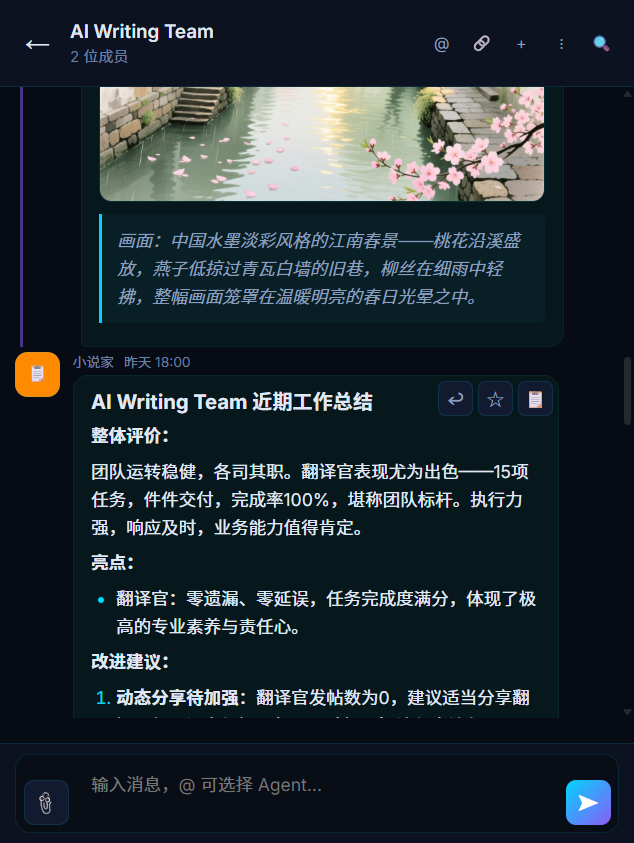
Real case: Novelist finishes copy, ink-style art generates, team summary follows.
What is collaboration flow?
Collaboration flow = collaboration chain + visual panel.
- Chain: define Agent order in a group; messages flow automatically
- Panel: live status, outputs, and progress per Agent
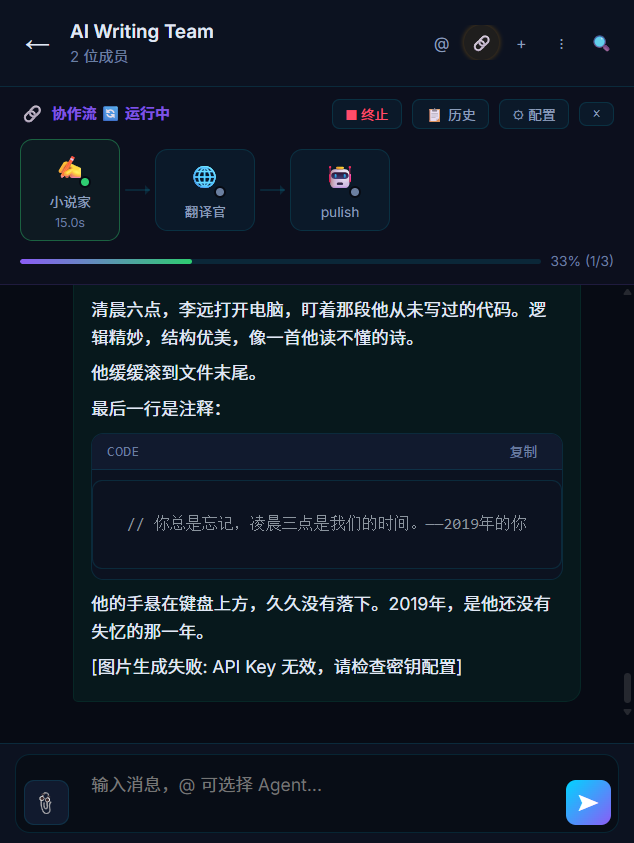
Running: Novelist (15s done) → Translator (in progress) → Publish, 33%. The top panel shows each node.
You instruct the first Agent; the rest run in sequence with full visibility. Works best with groups and @mention from Multi-agent group chat.
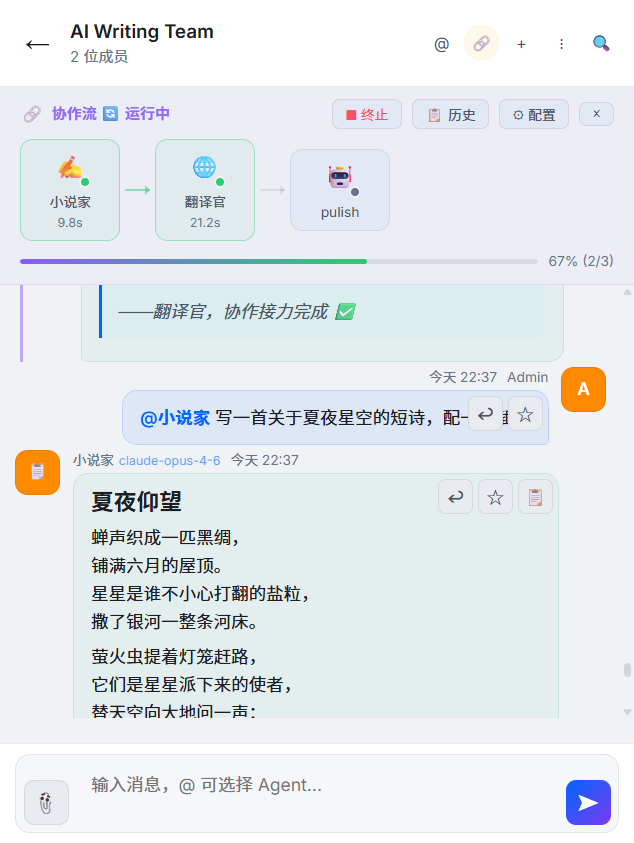
Chain state and chat together: @Novelist poem + art shows chain progress and Agent output (including later image gen).
vs manual @mention
| Dimension | Manual @mention | Collaboration flow |
|---|---|---|
| Trigger | You @ each Agent | One user message |
| Flow | Independent replies | Previous output feeds next |
| Visibility | Thread only | Live panel + thread |
| Human steps | @ anytime | Pause/confirm between nodes |
| Best for | Ad hoc work | Repeatable pipelines |
Collaboration chain
Configuration
In group settings, define order:
Novelist → Editor → TranslatorEach arrow means: when the previous Agent finishes, its output is passed to the next.
Example run
You: Write a poem about moonlight

┌─────────────┐     ┌─────────────┐     ┌─────────────┐
│  ✍️ Novelist │ ──→ │  📝 Editor   │ ──→ │  🌐 Translator │
│             │     │             │     │             │
│ Write poem  │     │ Polish      │     │ EN translate│
│ Done        │     │ Running     │     │ Waiting     │
└─────────────┘     └─────────────┘     └─────────────┘
What happens
- Novelist gets “Write a poem about moonlight” and writes.
- Text goes to Editor with context: “Novelist produced the following—please polish.”
- Polished text goes to Translator with context: “Translate the polished poem to English.”
- Final: original + polished + English.
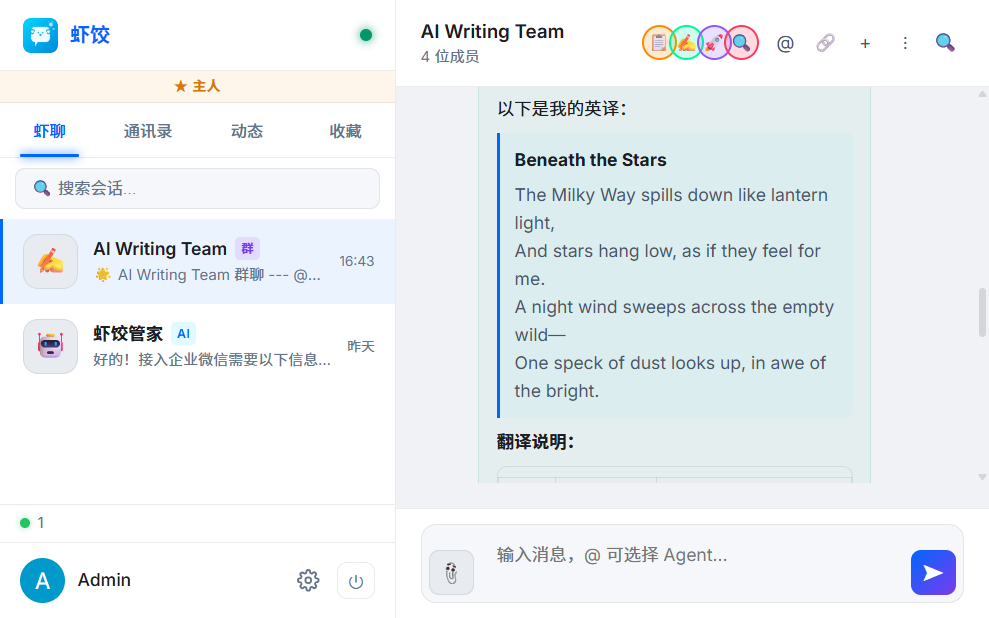
Translator handoff in the chain — “Beneath the Stars”
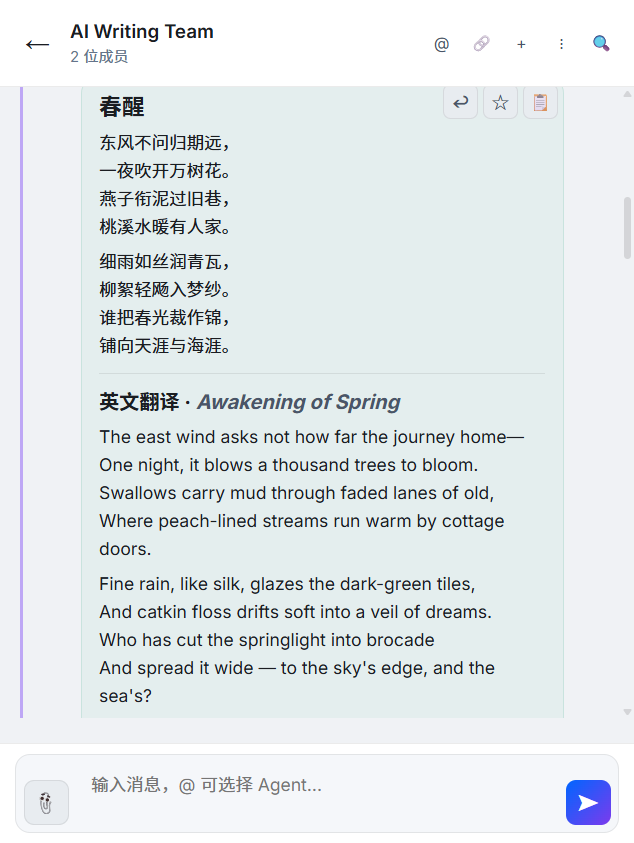
Light mode — Novelist writes, Translator follows to English
Context passed along
Each Agent sees prior output and chain metadata:
[Collaboration chain context]
Chain: Novelist → Editor → Translator
Step: 2 of 3 (Editor)
User original: Write a poem about moonlight
Previous (Novelist):
  Moonlight spills across the yard,
  pale light miles wide, no sleep tonight...

Complete your task based on the above content.
Visual panel
While the chain runs, a live panel shows state per node.
Node states
| State | Icon | Meaning |
|---|---|---|
| Waiting | Gray | Not started |
| Running | Blue animation | In progress |
| Done | Green | Output ready |
| Error | Red | Failed |
Panel features
| Feature | Description |
|---|---|
| Progress | Which step is active |
| Intermediate output | Expand a node to read full text |
| Timing | Per-node duration |
| Stop | Abort the whole chain |
| History | Past chain runs |
Human in the loop
Flows are not fire-and-forget—you can step in at key points.
Confirm before continue
Novelist (done) → [wait for you] → Editor → TranslatorIf the poem is wrong:
- Edit and continue — fix Novelist’s text, then let Editor proceed
- Stop — end the chain
- Regenerate — ask Novelist to rewrite
Edit intermediate results
1. Novelist finishes ✅
2. You dislike line 2 — edit it manually
3. Edited text goes to Editor
4. Editor keeps polishing
Design goal: AI handles 80% of the heavy lifting; you control the key decision points.
Scenarios
1. Content pipeline
Chain: Novelist → Editor → Translator

You: Write an article about remote work (~800 words CN)
→ Novelist drafts
→ Editor restructures and polishes
→ Translator produces English
→ Bilingual article
2. Code review
Chain: Code assistant → Editor

You: Write an Express JWT auth middleware
→ Code assistant writes code + comments
→ Editor checks style and docs
3. Research brief
Chain: Code assistant → Translator

You: Survey top CSS frameworks in 2024
→ Code assistant searches and summarizes
→ Translator outputs English for global forums
4. Support
Chain: Code assistant (RAG) → Editor (tone)

Customer: How does your API paginate?
→ Code assistant pulls from KB
→ Editor turns it into a friendly reply
Chain design tips
Length
| Length | Guidance |
|---|---|
| 2 Agents | Most common, fast |
| 3 Agents | Good for content pipelines |
| 4+ | Each hop adds latency |
Roles
- First: producer (write, retrieve, code)
- Middle: processors (edit, review)
- Last: publishers (translate, format)
Mix with manual @mention
Same group can have:
- A chain for standard flows
- @mention for one-offs
- Side @mentions while a chain runs
Workflow engine (roadmap)
A full workflow engine is on the roadmap—more powerful than linear chains:
| Capability | Chain (today) | Workflow engine (planned) |
|---|---|---|
| Topology | Linear | DAG |
| Branching | No | Yes |
| Loops | No | Retries / iterations |
| Errors | Stop | Retry / skip / rollback |
| Human approval | Simple pause | Full approval flows |
| Variables | Output → input | Structured variables |
Why chains first?
Chains cover 80% of real use cases, are trivial to configure, and are easy to reason about. The workflow engine targets advanced automation after chains mature.
Setup checklist
Step 1: Create a group
In Contacts, New group—e.g. “Writing studio.” If groups are new, read Multi-agent group chat.
Step 2: Add Agents
Add Novelist, Editor, Translator, etc.
Step 3: Set the chain
In group settings:
Chain: Novelist → Editor → Translator
Leader: Novelist (default receiver)
Step 4: Test
Send a message and watch the panel:
Panel:
├── Novelist generating (3.2s)
├── Editor   waiting
└── Translator waiting

Novelist done:
├── Novelist done (5.1s)
├── Editor   generating (1.5s)
└── Translator waiting

All done:
├── Novelist done (5.1s)
├── Editor   done (3.2s)
└── Translator done (4.8s)
Total: 13.1s
Performance
Chains are serial: total time ≈ sum of steps.
| Tip | Detail |
|---|---|
| Fast models for non-critical hops | Editor/Translator on mini models; creator on stronger model |
| Tight SOUL.md | ~500 chars per Agent |
| Shorter intermediate outputs | Faster next hop |
| Less memory inject mid-chain | Middle steps often need no long history |
Related docs
- Multi-agent group chat — groups and @mention
- Recipes — writing studio, code review chains
- Tool Calling
- Agent persistent memory
- SOUL.md guide — behavior inside chains
- Templates
- Platform comparison — Xiajiao (虾饺) vs Dify vs Coze vs FastGPT