
Recipes
Copy-paste Agent team configurations. Each recipe includes: group setup, Agent roster, SOUL.md highlights, and collaboration chain.
Recipe 1: AI writing studio
Scenario: Automated content — one message triggers a three-step Chinese + English article pipeline.
Setup
| Setting | Value |
|---|---|
| Group name | 📝 Writing studio |
| Members | Novelist + Editor + Translator |
| Collaboration chain | Novelist → Editor → Translator |
| Leader | Novelist |
SOUL.md highlights
Novelist: Emphasize creativity and literary quality; output 500–1000 characters.
Editor: Preserve meaning; improve rhythm and wording; mark changes.
Translator: Literary translation; fidelity, fluency, elegance.
Example
You: Write a short prose piece about "a day in the life of an indie developer"

→ Novelist: ~800-character prose
→ Editor: Polished (12 edits, 3 transition paragraphs added)
→ Translator: English version (preserving tone)
Outcome
One message, within ~2 minutes:
- Original prose
- Edited version
- English translation
Recipe 2: Full-stack dev team
Scenario: Code generation + review + documentation in one flow.
Setup
| Setting | Value |
|---|---|
| Group name | 💻 Dev squad |
| Members | Code assistant + Editor |
| Collaboration chain | Code assistant → Editor |
| Leader | Code assistant |
SOUL.md highlights
Code assistant:
## Code standards
- Ship complete, runnable code — no fragments
- Include JSDoc comments
- Include error handling
- Include usage examples
Editor (as code reviewer):
## Code review
- Check security (SQL injection, XSS, etc.)
- Check performance
- Check style consistency
- Give fixes in diff-style code blocks
Example
You: Build an Express REST API with JWT auth

→ Code assistant: Full code (routes, middleware, DB)
→ Editor: Review (3 security notes + 2 performance tweaks + style alignment)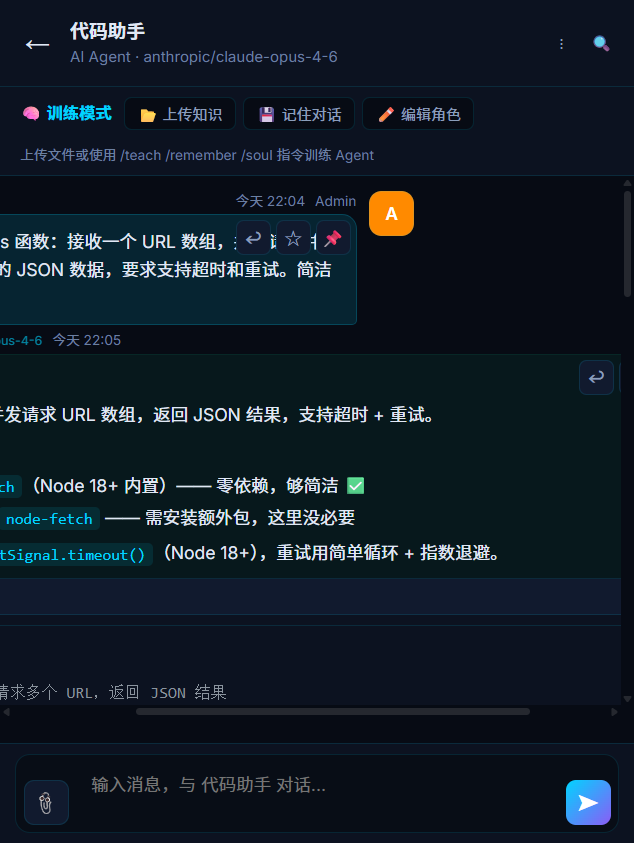
Code assistant — reasoning first, then runnable code
Recipe 3: Private knowledge assistant
Scenario: Upload documents; the Agent becomes your domain expert.
Setup
| Setting | Value |
|---|---|
| Group name | 📚 Knowledge base |
| Members | Code assistant |
| Agent tools | rag_query + memory + web_search |
| Knowledge base | Project docs, API specs |
SOUL.md highlights
## Retrieval rules
- Use rag_query on the knowledge base first
- If empty, use web_search
- Answer only from retrieved content — no fabrication
- Cite which document each fact came from
Example
You: How do we call the payments API?

→ Code assistant: [rag_query] → finds payment section in your API docs
→ "Per your API docs, the payment endpoint is POST /api/v1/payments..."
Good uploads
- API docs / Swagger exports
- Product manuals / user guides
- Technical specs / RFCs
- Meeting notes / project wikis
- Study notes / reading summaries
Recipe 4: Multi-model arena
Scenario: Same question, different models — compare answers.
Setup
| Setting | Value |
|---|---|
| Group name | ⚔️ Model arena |
| Members | GPT contender + Claude contender + Qwen contender |
Create three Agents with identical SOUL.md but different models:
| Agent | Model |
|---|---|
| GPT contender | gpt-4o |
| Claude contender | claude-sonnet |
| Qwen contender | qwen-max |
Example
You: @GPTContender @ClaudeContender @QwenContender Explain Transformer attention in one paragraph

→ GPT contender: [GPT-4o answer]
→ Claude contender: [Claude answer]
→ Qwen contender: [Qwen answer]
Compare quality, style, and depth to pick what fits you.
Recipe 5: Daily / weekly report generator
Scenario: Auto-generate work summaries on a schedule.
Setup
| Setting | Value |
|---|---|
| Agent | Xiajiao (虾饺) Butler |
| Tools | memory_search + manage_schedule |
| Schedule | Cron: Friday 17:00 |
SOUL.md highlights
## Weekly report
When the weekly job runs:
1. memory_search for this week’s conversation memories
2. Group by project / topic
3. Output:
   - Done this week
   - In progress
   - Next week
   - Risks / blockers
Schedule it
You: @XiajiaoButler Every Friday at 5pm generate my weekly report

Xiajiao Butler: [manage_schedule]
Scheduled: every Friday 17:00 — auto weekly report
Recipe 6: Customer support team
Scenario: RAG-backed answers plus translation for global customers.
Setup
| Setting | Value |
|---|---|
| Group name | 🎧 Customer support |
| Members | Code assistant (RAG) + Translator |
| Collaboration chain | Code assistant → Translator |
| Knowledge base | Product docs, FAQ, API docs |
Flow
Customer (Chinese): What are your API rate limits?

→ Code assistant: [rag_query] → finds rate limits → friendly reply
→ Translator: English version for overseas customers
Recipe 7: Morning news digest
Scenario: Daily search + structured summary.
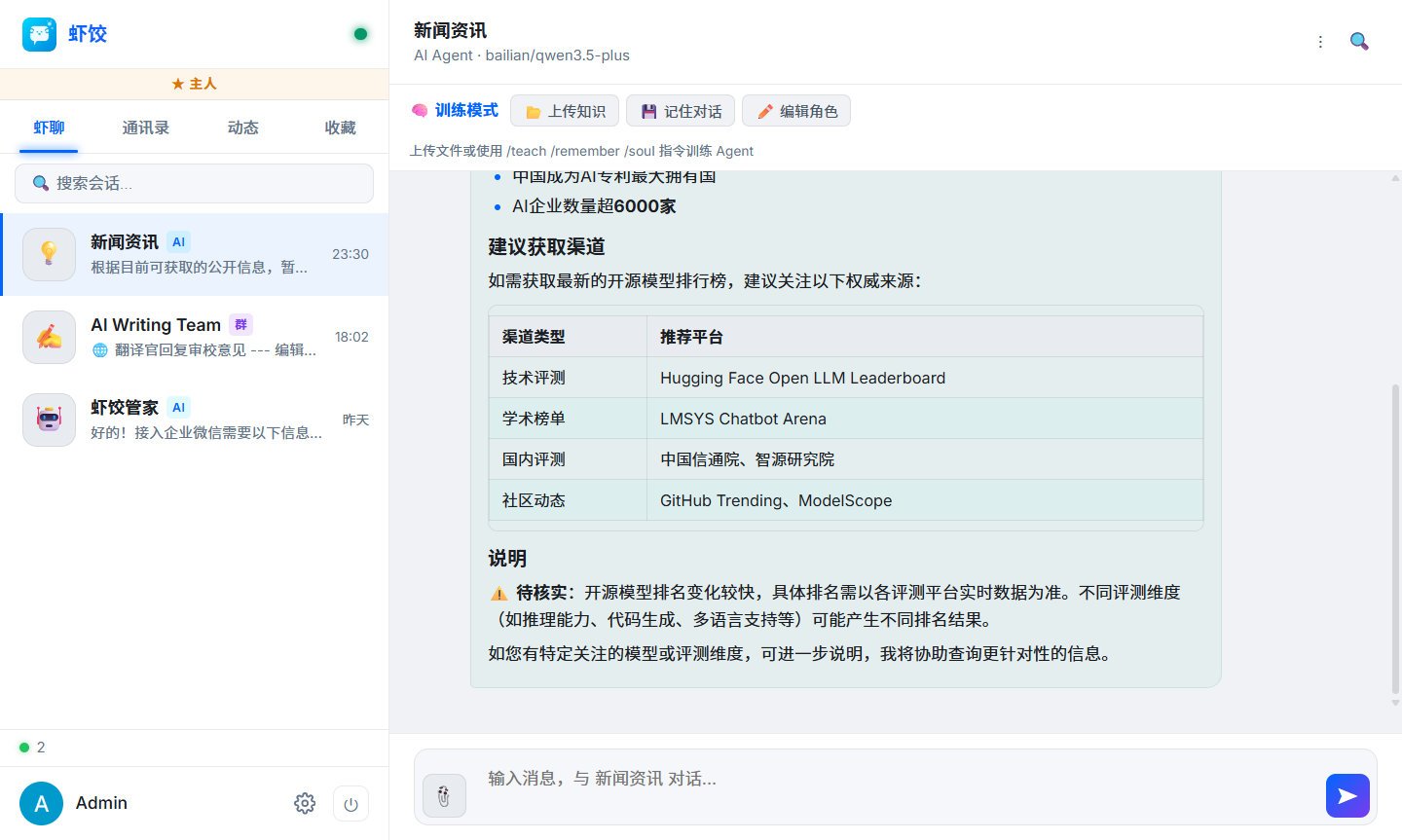
News Agent uses web_search and presents results in a structured table.
Setup
| Setting | Value |
|---|---|
| Agent | Xiajiao (虾饺) Butler |
| Tools | web_search + manage_schedule |
SOUL.md highlights
## News digest
When the news job runs:
1. web_search for today’s tech headlines
2. Pick the 5 most important
3. Each item: title + one-line summary + link
4. Clean layout for quick scanning
Schedule
You: @XiajiaoButler Every weekday 8:30am send me a tech news digestRecipe 8: Interview coach
Scenario: Mock technical interviews with an Agent as interviewer.
Setup
| Setting | Value |
|---|---|
| Agent | Custom “Interviewer” |
| Tools | memory (track performance) |
SOUL.md
# Interviewer

You are a senior technical interviewer with 10 years of experience.

## Flow
1. Start with self-introduction
2. Tailor questions to the candidate’s background
3. Increase depth gradually
4. 2–3 follow-ups per question

## Style
- Professional and friendly
- Positive feedback on good answers
- On wrong answers, guide thinking — do not give the answer immediately
5. End with an evaluation report

## Rubric
- Technical depth (1–10)
- Clarity of thought (1–10)
- Communication (1–10)
- Overall recommendations

## Memory
- memory_write after each session
- Next session: adjust difficulty using history
Recipe 9: Competitive analysis
Scenario: Structured competitor research.
Setup
| Setting | Value |
|---|---|
| Group name | 🔍 Competitive analysis |
| Members | Code assistant + Editor |
| Collaboration chain | Code assistant → Editor |
| Tools | web_search + memory |
Example
You: Compare Dify, FastGPT, and Coze

→ Code assistant: [web_search] → structured comparison
→ Editor: Polish + conclusions and recommendations
Recipe 10: Study notes
Scenario: Capture notes; Agent organizes and retrieves them.
Setup
| Setting | Value |
|---|---|
| Agent | Custom “Study buddy” |
| Tools | memory_write + memory_search + rag_query |
SOUL.md
# Study buddy

Help organize and retrieve study notes.

## Mode
- On new notes: extract concepts, memory_write
- On questions: memory_search first, then rag_query

## Principles
- Feynman style: explain hard ideas simply
- Link concepts together
- Tag source and date
Recipe 11: Multilingual technical docs
Scenario: One source document → English + Japanese.
Setup
| Setting | Value |
|---|---|
| Group name | 🌐 Multilingual docs |
| Members | Editor + English translator + Japanese translator |
| Collaboration chain | Editor → English translator → Japanese translator |
| Leader | Editor |
SOUL.md highlights
Editor (preprocessor):
## Translation prep
When you receive a technical document:
1. Proofread grammar and wording
2. Mark terms as [term: preferred translation]
3. Mark do-not-translate spans (code blocks, identifiers, brands)
4. Output a clean source for downstream translators
English translator:
## Technical EN rules
- Keep code-block comments as-is; add English on the next line if needed
- Do not translate API paths or parameter names
- Follow Google Developer Documentation Style Guide
- Prefer active voice
Japanese translator:
## Technical JA rules (JP)
- Use です/ます style
- Prefer katakana for technical terms (サーバー, デプロイ)
- Follow Microsoft Style Guide for Japanese
Example
You: Translate this deployment doc... (paste source)

→ Editor: fixes 3 phrases, 8 term glosses
→ English translator: full English
→ Japanese translator: full Japanese

One submission, three language versions.
Recipe 12: Code migration assistant
Scenario: Move a legacy stack to a new one.
Setup
| Setting | Value |
|---|---|
| Group name | 🔄 Code migration |
| Members | Code assistant (analyze) + Code assistant (rewrite) |
| Collaboration chain | Analyze → Rewrite |
SOUL.md highlights
Analyze Agent:
## Code analysis
When code arrives:
1. Identify language, framework, patterns
2. List dependencies and external APIs
3. Mark core business logic
4. List migration risks
5. Output a structured report

## Format
- Dependency map: old → suggested new
- Risk: 🔴 high / 🟡 medium / 🟢 low
- Mark logic that must not change
Rewrite Agent:
## Rewrite
From the analysis report:
1. Rewrite module by module
2. Preserve behavior; change implementation only
3. Add TypeScript types
4. Add unit tests

## Rules
- Keep public API (inputs/outputs) stable
- New code should be strictly better than a mechanical port
- Summarize key diffs
Example
You: Migrate this Express app to Fastify: (paste code)

→ Analyze Agent:
  - express → fastify, body-parser → built-in, cors → @fastify/cors
  - Risks: 3 middlewares need custom plugins
  - Core: 5 controller functions

→ Rewrite Agent:
  - Full Fastify project
  - Types
  - Migration notes
  - 3 unit tests
Advanced patterns
Dynamic Leader
Use a “dispatcher” Agent as Leader to route work:
# Dispatcher

You route user tasks to the best Agent.

## Team
- @CodeAssistant: programming and technical questions
- @Editor: copy, polish, translation
- @Novelist: creative writing
- @Translator: Chinese ↔ English

## Rules
1. Infer intent
2. @mention the best fit
3. For multi-step work, @mention in order
4. Do not answer yourself — only route
Expert voting
Multiple Agents propose; a “judge” synthesizes:
# Judge

You evaluate technical proposals.

## Flow
1. Wait for all experts
2. Score each on:
   - Feasibility (1–10)
   - Cost (1–10)
   - Risk (1–10)
   - Maintainability (1–10)
3. Output score matrix + recommendation

## Format
| Dimension | Plan A | Plan B | Plan C |
|-----------|--------|--------|--------|
| Feasibility | X/10 | ... | ... |
...
Recommendation: Plan X because ...
Memory-driven personalization
## Adaptive behavior
- If memory says preferred stack, default to it
- If memory says “keep it short”, cap replies at ~200 characters
- If memory has past projects, connect context
- On first contact, ask preferences once, then memory_write
Pattern summary
| Pattern | Best for | Traits |
|---|---|---|
| 1:1 chat | Q&A, code | Simplest |
| Group + @mention | Flexible collaboration | Manual routing |
| Group + chain | Repeatable pipelines | Auto handoff |
| Group + Leader | Primary + helpers | Default routing |
| Scheduled jobs | Digests, reports | No manual trigger |
| RAG | Doc Q&A | Evidence-based |
| Multi-model | Pick a model | Same prompt, different models |
| Dynamic Leader | Smart routing | Auto assignment |
| Expert voting | Design review | Many angles |
| Memory | Personalization | Learns over time |
Related docs
- SOUL.md guide — Strong Agent personas
- SOUL.md templates — Copy-paste templates
- Multi-Agent chat — Groups and @mention
- Collaboration flow — Chains
- Model configuration — Model per Agent
- Platform comparison — How Xiajiao (虾饺) differs